Medical Student Training in Aging Research (MSTAR) Program
PIs: Benjamin Han, MD, MPH and Ellen Lee, MD
The MSTAR program is funded by the National Institute on Aging and has been offered at UC San Diego since 2005. Each year, this popular program provides up to 18 medical students from across the nation an opportunity to conduct 2 to 3 months of summer research guided by the mentorship of a UC San Diego faculty member. Students receive fulltime training conducting hands-on research in an area of personal interest pertaining to aging or an age-related disorder. Additionally, students participate in a variety of clinical activities and didactics that help shape their knowledge base related to aging and teach valuable skills needed to conduct research. Students are provided an opportunity to showcase their work locally and encouraged to travel to the Annual Meeting of the American Geriatrics Society to present their findings.
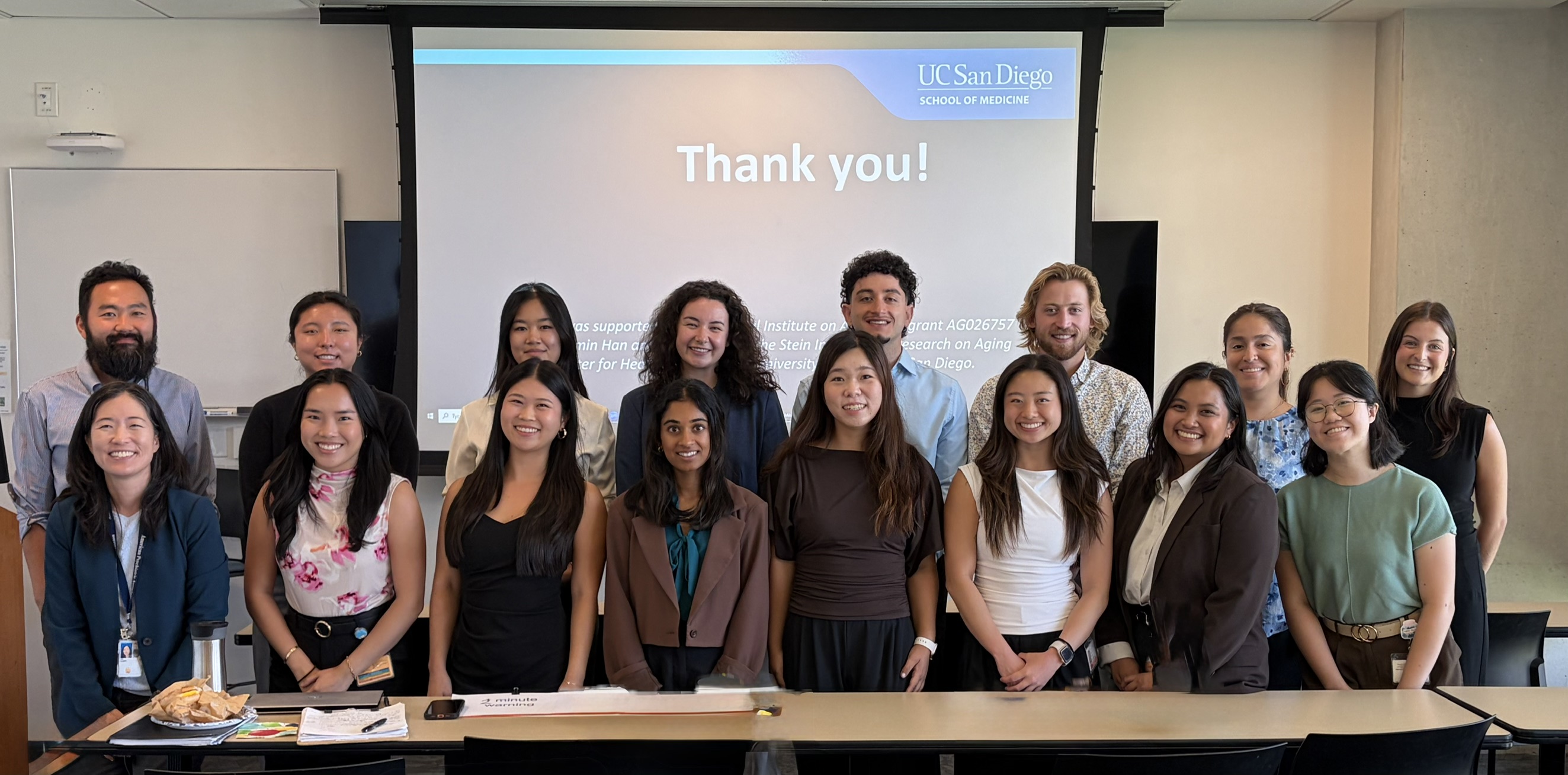
MSTAR summer class of 2026 at their final presentation with MSTAR PI's Drs. Benjamin Han & Ellen Lee.
Prior MSTAR Projects:
Eligibility
In order to apply to the UCSD MSTAR Program, students must fulfill the following requirements:
- Any allopathic or osteopathic medical student in good standing, who will have successfully completed one year of medical school at a U.S. institution before starting the program is eligible to apply.
- Applicants must be citizens of the United States or must have been lawfully admitted for permanent residence. Individuals on temporary or student visas are not eligible.
- Students holding PhD, MD, DVM, or equivalent doctoral degrees in the health sciences are not eligible to apply.
- Applicants may not hold another award, grant or participate in another program concurrently with the MSTAR program.
- Research project must be focused on aging.
- Students must participate in the program full-time for a minimum of 2 months (8 weeks) and a maximum of 12 weeks. The weeks must be continuous.
- The earliest students can start the program is mid-May or later.
- Students must be available to particapate in the program entirely in person with no full or partial remote option available
Non Discrimination Statement
In accordance with applicable Federal and State law and University policy, the University of
California does not discriminate, or grant preferences, on the basis of race, color, national origin,
religion, sex, disability, and/or other protected categories.
More information about Proposition 209 can be found here.
More information about the University of California Anti-Discrimination Policy can be found here.
How to Apply
The 2027 Summer MSTAR Application will open on Tuesday, November 3
Please note, the application website- Qualtrics will not save your progress. We recommend reviewing the attached PDF and prepare your application in advance.
Required attachments for your application:
- Resume/CV
- Home Institution Faculty Sponsor Form:
- Must be completed by your Faculty Sponsor and emailed back to you for upload.
- Faculty Sponsor must attach a recent version of their NIH biosketch. If they do not have a biosketch, they may attach their CV instead.
- Personal Statement Form
- Prompt: "Describe your past experiences, expectations for the program, future goals, and any other information you would like the review committee to consider. Your statement should address your interest in geriatrics or aging research, explain how this interest connects to your listed honors, activities, and coursework, and describe why you are interested in this program in particular."
- Maximum: 750 words
- Definitions:
- Home Institution Faculty Sponsor: A faculty member from the applicant's medical school
- UCSD Faculty Mentor: If selected for the MSTAR program, you will be assigned a UCSD Faculty Mentor who will work with you during the program. Applicants do not need to secure a UCSD mentor in advance.
Stipend
The MSTAR stipend is approximately $2,399 per month, with a minimum requirement of 2 months of full-time participation. The total stipend is prorated based on the number of weeks you complete and is paid out in two to three installments.
Important Payment Policies:
-
Paid in Arrears: Stipends are paid on the first of the month for active participation during the prior month.
-
For example: If your program start date is June 1st, you are earning your stipend throughout June, and your first payment would be July 1st.
-
-
Eligibility Criteria: To qualify for the stipend, students must be actively participating in the program full-time. Stipend payments will not be issued before your official start date or before you actually begin your research.
Housing
Additional funds for travel and housing are not provided. Students coming to UC San Diego from another medical school please visit UCSD housing resources. For students who do not have a car during Summer MSTAR, there are several mass transit routes that serve the campus and surrounding area. For more information, please visit UCSD transportation site.
Curriculum
Along with the research component of the program, students will be able to participate in clinical rotations, didactic sessions, and workshops.
Didactic Training
Students will spend the majority of their time working on a research project alongside a faculty mentor but will also be required to attend didactic sessions. Didactics will be held once a week and varies topics will be presented.
Didactics sessions will give students the opportunity to learn aboutresearch ethics, publication strategies, and talks on aging-relatedtopics. For a list of last year’s topics please see the didactics’ schedule.
Poster and Presentation
At the end of the summer, students will be responsible for puttingtogether a ten-minute presentation for a workshop.The goal of the workshop istoshare withtheir fellow MSTAR colleaguestheir summer project. Additionally, students will needtowrite an abstract at the end of the program, and we encourage everyonetosubmit ittothe American Geriatrics Society (AGS) conference.Previous UCSD MSTAR students have published their summer work in major peer-reviewed journals, including the Journal of the American Geriatrics Society, JAMA Ophthalmology, The American Journal of Geriatric Psychiatry, Age and Ageing, Journal of Acquired Immune Deficiency Syndromes, and PLOS One.
Questions?
For more information about the MSTAR program, please email us at lajimenez@health.ucsd.edu.
Please visit the AFAR website for more information on the program, eligibility, and application guidelines.